DSLR CAMERA
Law of Total Internal Reflection
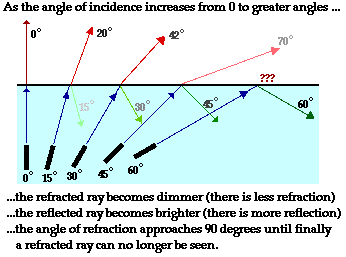
Total internal reflection is the phenomenon that involves the reflection of all the incident light off the boundary. For total internal reflection to work, the following conditions have to be met:
-
the light is in the more dense medium and approaching the less dense medium
-
the angle of incidence is greater than the critical angle
Without these two conditions, total internal reflection is not possible. The ray of light approaching the less dense medium is known as the incident ray. The angle that is reflected and leaving from the dense medium is known as the reflected ray. At the point of incidence, a perpendicular line labelled the normal, can be drawn from the boundary. The angle between the incident ray and the normal is known as the angle of incidence.The angle between the reflected ray and the normal is known as the angle of reflection. The angle of incidence is labelled as "theta-i", and the angle of reflection is labelled as "theta-r". The angled of incidence is always equal to the angle of reflection.
Total Internal Reflection in a DSLR camera
The pentaprism in a DSLR camera enables the light rays from the image to reach the viewer's eyes. Once the light rays leave from the reflex mirror it hits and reflects off two sides of the pentaprism before the ray reaches the eyepiece (view-finder). As shown in the diagram, if the light ray's trajected path were to be drawn, it would create a right angled triangle. This is because the only way for the light rays to bend from the camera lenses to reach the eyepiece, is to have gone through the pentaprism. Without the pentaprism and total internal reflection, the DSLR camera would not be functional.

