DSLR CAMERA
The Law of Reflection
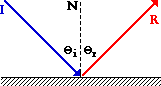
The ray of light approaching the mirror is called the incident ray (I). The ray of light leaving the mirror is known as the reflected ray (R). At the point of incidence (where the ray hits the mirror), a line can be drawn perpendicular to the mirror. This line is known as the normal (N). The normal line divides the angle between the incident ray and the reflected ray into two equal angles. The angle between the incident ray and the normal is known as the angle of incidence.The angle between the reflected ray and the normal is known as the angle of reflection. The angle of incidence is labelled as "theta-i", and the angle of reflection is labelled as "theta-r". The angled of incidence is always equal to the angle of reflection.

Reflection in a DSLR Camera
As a person looks through a DSLR camera's eyepiece, a clear image can be seen. Though how this image is created is unknown to many. One of the phenomenons used to create this image is reflection. Reflection is performed as the light rays pass through the camera lenses and hit the reflex mirror that sends the light rays towards the pentaprism (refer to diagram). The mirror is positioned in a way so that once the incident ray hits the mirror, the reflected ray will be trajected towards the pentaprism. The sum of the angle of incidence and reflection is always 90 degrees as it heads towards the pentaprism. Without the reflex mirror, and the law of reflection in use, an image could not be formed.
